Attractions
 Today, Ho Chi Minh City has a lot of attractions, some purpose-built for tourists, but many others have been for historical reasons. To choose between the museums, see the city museums, compared by ticket and time needed.
Situated near the middle of the city, Dam Sen Water Park is a great place to cool off
Ben Duoc Monumental Temple
Built in the same style as a traditional Vietnamese temple, the Ben Duoc Monument is a monument to the war martyrs, to remember the people who loss their lives in the south of Vietnam during the Vietnam War. The memorial day is the 19th of December. It is near to the Cu Chi Tunnels.
Excavated with simple hand tools in the 1940s, the Cu Chi Tunnels stretched all around Ho Chi Minh City, allowing the Viet Cong easy access around the region, as well as a hiding spot at night. Today, it attracts many tourists trying to get a small taste of what life was like in the Vietnam War.
Ho Chi Minh City Fine Arts Museum
Opened in 1991, the Fine Arts Museum consists of three floors, with exhibits by Vietnamese artists as well as foreign artists. There are many items on display, including Champa and Oc Eo work, antique Vietnamese ceramics, and traditional Vietnamese handicrafts. Admission: VND 60,000 (US$2.40) per visit, with a 50% reduced rate of VND 30,000 (US$1.20) for children aged 6 to under 16, pupils and students in the Vietnamese education system, Vietnamese citizens aged 60 and over, people with severe disability and the cultural-preference groups named on the museum's price table; free for children under 6, people with especially severe disability and poor households. Hours: 8:00 AM - 5:00 PM daily.
Nam Bo Women's Museum
The Nam Bo Women’s Museum opened in 1985 as a place for meetings, education, and cultural exchanges between women. The museum consists of 10 display rooms, a movie theatre and a library on the traditions of women.
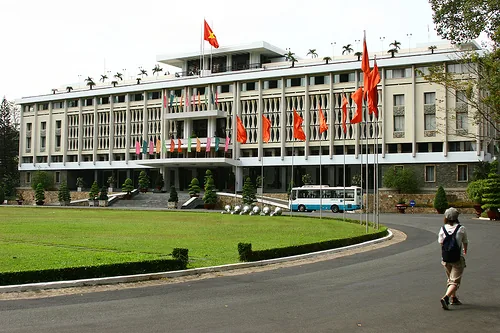
Officially known as the Thong Nhat Conference Hall, this building was where the French Governor would have lived. It was then rebuilt in 1966 by the President of South Vietnam. On the 30th of April, 1975, the Palace was taken by the Viet Cong, and turned into a temporary location for an ‘Administrative Committee’. In December 1975, the palace was used to announce the national reunification. Admission: VND 80,000 (US$3.00) for adults including the exhibit, or VND 40,000 (US$1.60) for the palace only. Hours: 07:00 - 18:00 daily. See our Independence Palace visitor guide for full ticket tiers and gate times.
War Remnants Museum
Opened in 1975, it contains items and photographs from the Vietnam War. With a special focus on American war crimes, may photos show civilians being killed, or bombs and chemicals being dropped. Outside, jeeps, tanks, planes, and helicopters are on display. Despite being obviously biased, around a million foreign visitors have been to the museum, including American tourist. It may not be the fairest representation of history, but it is what the Communist Party believes. Admission: from 1 October 2026, VND 60,000 (US$2.40) for adults, with a 50% reduced rate of VND 30,000 (US$1.20) for older visitors, people with severe disabilities, meritorious-service families, artisans and the other concession groups named on the ticket page; children accompanied by a parent or family member enter free (collect the ticket at the counter), and pupils, students and poor or near-poor households enter free after registering online. Hours: 07:30 - 17:30 daily, including public holidays and Tet; the ticket counter and last admission close at 17:00.
One of the biggest and most popular markets in Ho Chi Minh City for tourists, Ben Thanh Market has lots of different products for tourists and locals to buy. However, it does have more clothes and souvenir shops than other markets due to the large amount of tourists. The market is a great place to practice bargaining, and perhaps pick up a good deal or two, but there is the danger of pickpockets.
Also known as Chinatown, Cholon literally means “Big Market”. In 1778, the Chinese residents of Bien Hoa fled to what is now Cholon. As Saigon grew bigger, it gradually merged into one city. In 1931, the city had been renamed as Saigon-Cholon, and by 1956, it had become part of Saigon. During the Vietnam War, the market sold lots of American of US Army issued items. Today, it attracts many Chinese tourists, as well as people wanting to buy US Army Hardware.
The observation deck on floors 79 to 81 of Landmark 81, the tallest building in the city.
Several of the city's best stops cost nothing at all. The Saigon Central Post Office is free to walk through during opening hours. Nguyen Van Binh Book Street, a pedestrian lane, is free to wander, and so is the browsing at Ben Thanh and at Binh Tay in Cholon — at either market you pay only for what you buy. No ticket is sold at any of the four, checked on 20 November 2026 — the city's own listing for Ben Thanh (visithcmc.vn/vi/cho-ben-thanh, where neither vé nor miễn phí appears) and the market's own regulations page (benthanhmarket.vn/about/noi-quy-cho.html, likewise none); neither the Post Office nor Book Street publishes a page that prices entry at all, and Binh Tay's own market board publishes no entry price either, so there is no figure to quote for any of the three.
When the walking and the heat catch up with you, our guide to spa and massage options in Ho Chi Minh City covers what is available in each district and what a session costs.
For the wider picture, our guide to eating and getting around Ho Chi Minh City covers street food, what a Grab ride costs and the metro line.
|